A two-year-old distributed solar developer in Abuja is turning Nigeria's power gap into a repeatable installation business. The traction is early. The commercial moment is real.
Nigeria's national grid delivers roughly 31% of its installed generation capacity to end users. That figure has circulated through policy documents, development reports, and investor decks for years. What rarely gets stated plainly is what fills the gap. It is not empty. It is full of diesel generators, petrol machines, and kerosene lanterns: expensive, polluting, and technically unreliable. Every hospital running on diesel, every SME absorbing generator economics, every peri-urban community paying fuel prices for its electricity is living that 69% shortfall.
Adage Renewables, a distributed solar developer founded in Abuja in 2023, is building the alternative. The company designs, finances, installs, and operates off-grid solar hybrid systems for communities, businesses, and institutions that the national grid does not reach or does not serve reliably. In Q1 2026 it completed its first commercial hospital project. That is a meaningful proof point for a company less than three years old.
Two things have changed the commercial equation for what Adage is doing. Battery levelised cost of energy (LCOE) crossed $100 per kilowatt-hour for the first time in 2025. And Brent crude at $126 has pushed diesel running costs to levels that make a three-to-five-year payback on a solar-storage system viable for most commercial applications. The policy argument for distributed solar has existed for a decade. The arithmetic that actually closes deals is newer.
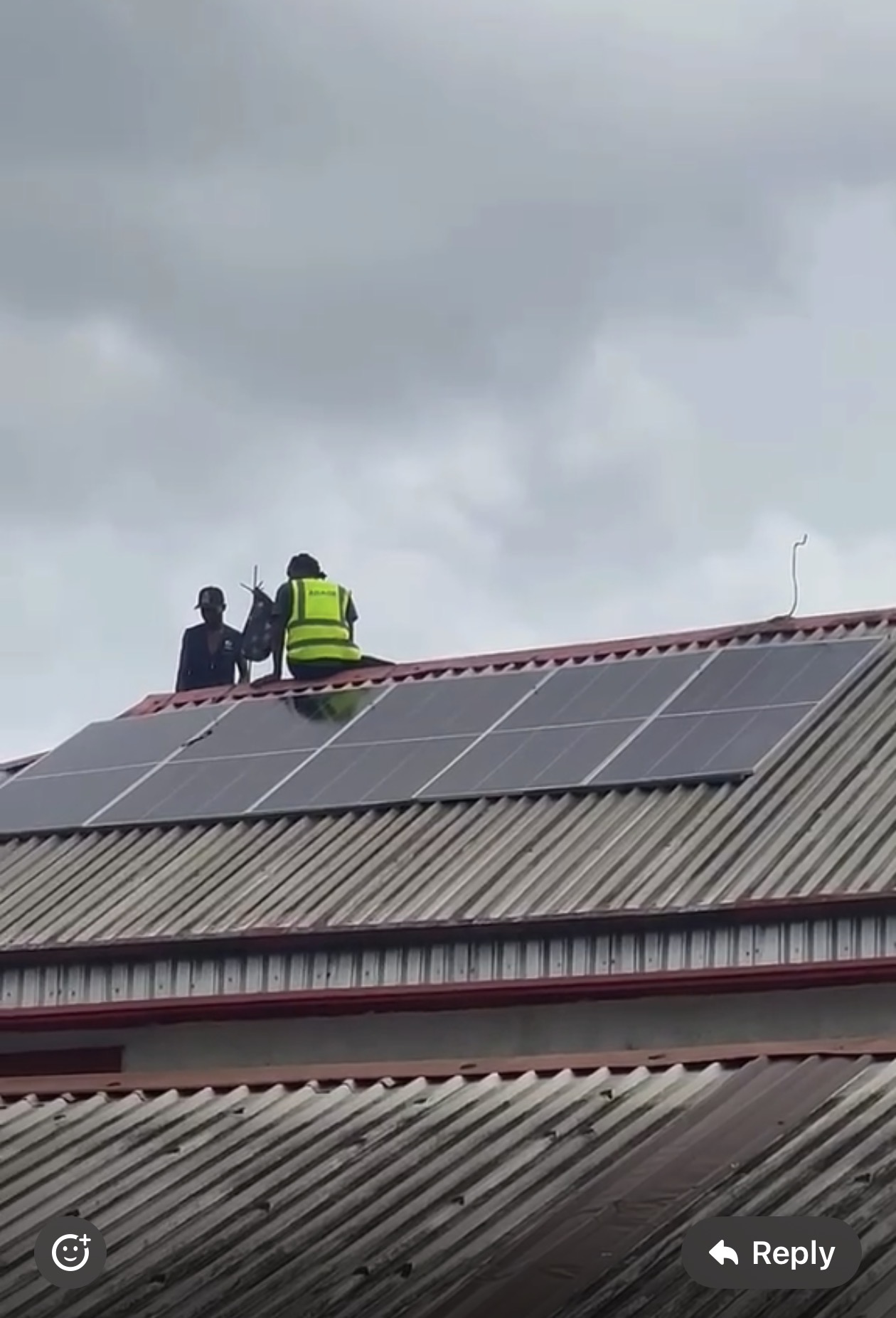
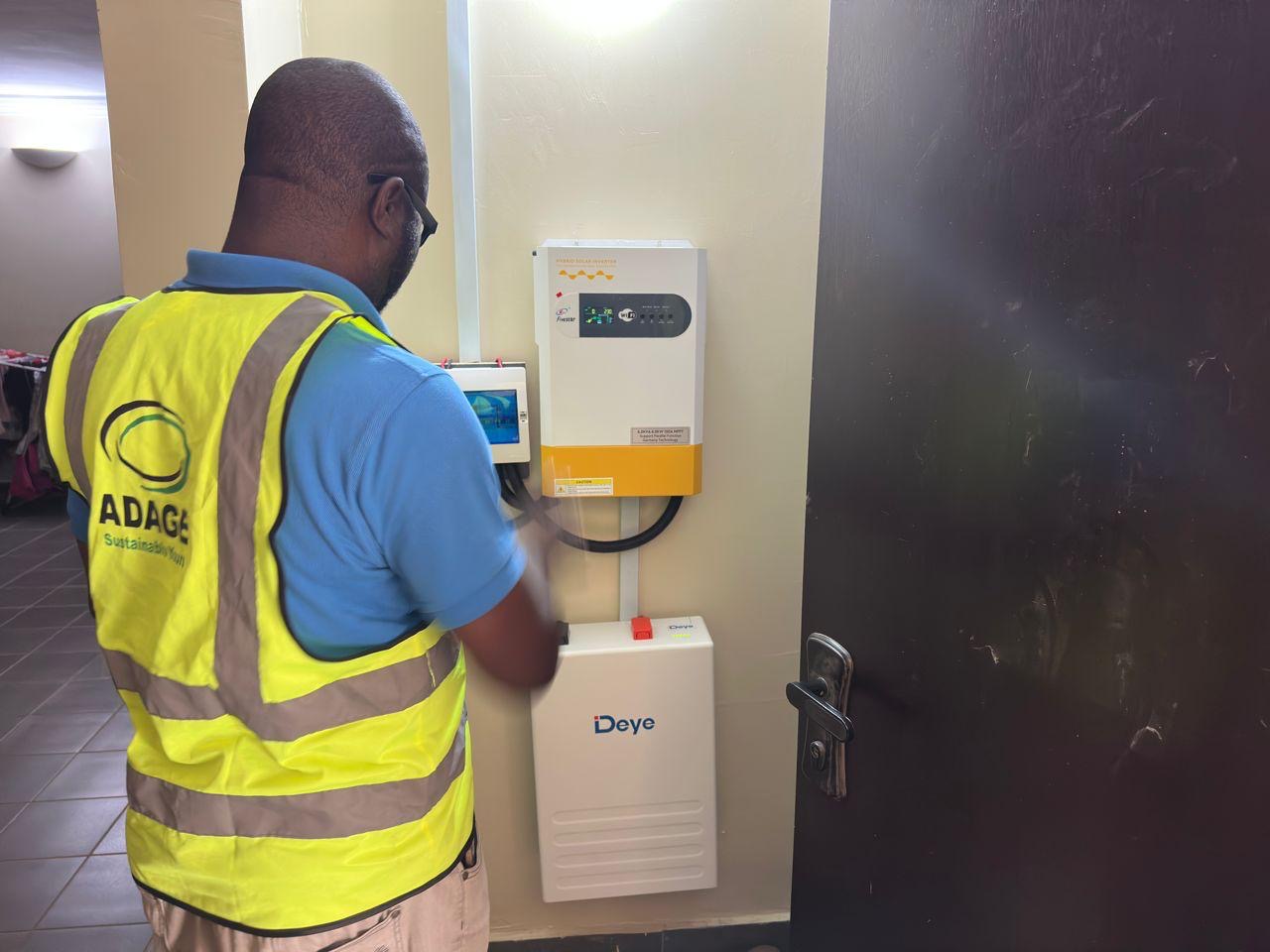
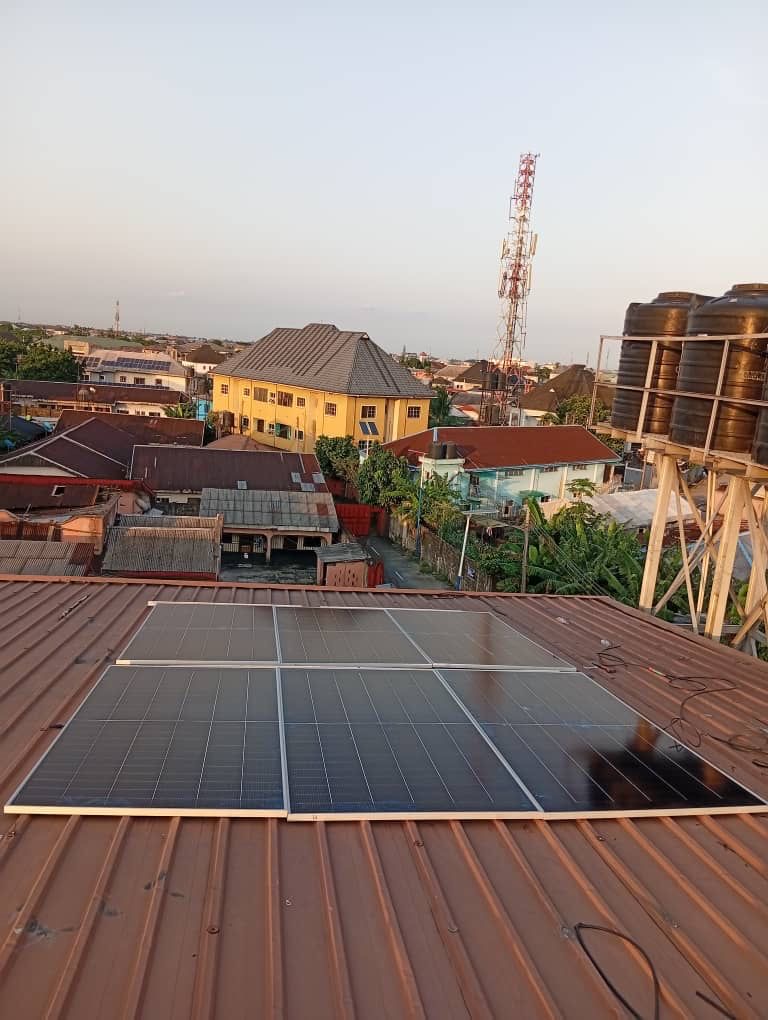
Each Adage system combines three core components: high-efficiency monocrystalline photovoltaic panels, lithium-ion battery storage, and a smart hybrid inverter that manages the interaction between solar generation, stored power, and any remaining grid or generator input. The architecture is modular. Systems can be sized for a household, a small business, or an institution. They can be expanded as load grows without replacing what is already installed.
The customer journey starts with a load assessment. Adage engineers evaluate energy demand, site conditions, and available solar irradiance before proposing a system design. Installation includes commissioning and user training. Maintenance contracts carry the relationship forward. Adage retains a service stake in the system's performance rather than treating each project as a one-time transaction. That matters for the institutional clients (hospitals, commercial facilities, multi-building campuses) that require long-term reliability guarantees.
Operations span Port Harcourt and Abuja. The team is 5 to 7 core leadership and operational staff, supported by field technicians and a physical marketing network. As of June 2026, front-desk and administrative hires are underway, a signal of operational formalisation ahead of the next growth phase.
Q1 2026 figures per company questionnaire. First commercial hospital project completed within this period. kWp = kilowatts-peak (solar panel rated output). kWh = kilowatt-hours (battery energy capacity).
The 600 million Africans without reliable electricity access are not a single category. Many are grid-connected in name but off-grid in practice. In Nigeria the distinction matters. Per NERC data, installed generation capacity runs at roughly 31% utilisation. Grid connections exist on paper across communities and commercial zones where power arrives intermittently, when it arrives at all. The result is that households and businesses absorb the cost and emissions of self-generation at scale, year after year.
Off-grid solar has been a recognised solution for over a decade. Most of that time the market concentrated on pay-as-you-go solar home systems: small panels, small batteries, mobile payment, rural residential customers. Adage operates in a different and historically underserved segment. Its customers are commercial and institutional clients in peri-urban areas with more complex load requirements. They need hybrid systems that manage variable solar output, battery storage, and backup power simultaneously. That segment was harder to finance and harder to standardise when the cost curves were less favourable. They are considerably more favourable now.
The Nigeria Electricity Act 2023 has also cleared some of the regulatory friction. The Act provides clearer licensing pathways for mini-grid operators and distributed generators and enables state-level electricity markets for the first time. For a company like Adage, that removes uncertainty that previously made project structuring difficult.
Adage has 12 paying installation customers as of early 2026. That is a modest number. It is also an honest one. At a stage when distributed solar companies routinely overstate pipeline as delivered capacity, 12 paying customers with 80 kVA of installed inverters and a completed hospital project is a more credible foundation than a larger number with thinner evidence behind it.
The hospital project is the most meaningful data point. Healthcare facilities impose uptime requirements, load management complexity, and safety standards that residential projects do not. Completing one successfully demonstrates that Adage's engineering and installation capability extends to institutional-grade demand. That expands the addressable market from residential and SME customers into clinics, schools, cold-chain facilities, and commercial campuses.
The Niger Delta Chambers of Commerce, Industry, Trade, Mines and Agriculture has provided financial backing. The amount was not disclosed in the questionnaire. As a local institutional endorsement it carries regional credibility in one of Nigeria's most commercially active energy zones.
The distributed solar market in Sub-Saharan Africa has grown substantially but unevenly. The rural residential segment (pay-as-you-go solar home systems, mobile money, small panels) attracted the most capital and produced the most headline customer numbers. The commercial and institutional segment received less attention partly because the economics were harder and the deal sizes were smaller than utility-scale projects.
That calculus is shifting. Storage cost declines have made hybrid systems viable for commercial loads that solar alone could not serve reliably. The fuel cost environment has improved payback times. And the Nigeria Electricity Act 2023 has created a more structured regulatory pathway for peri-urban and mini-grid developers. Several developers are working in this space across Nigeria, including Rensource, Husk Power, and GridX among them at different scale and geography points. Adage is building from a smaller base with a narrower current footprint. The hospital project signals it has the technical capacity to move up the complexity curve if capital follows.
The company is registered under Nigerian company law, operates under NERC's embedded generation framework, and aligns its displacement activity with the Nigeria Energy Transition Plan. No carbon standard registration is in place yet. The activity qualifies for Verra VCS or Gold Standard renewable energy methodology. Whether Adage pursues that pathway depends partly on whether the administrative cost and timeline is viable at current project scale.
Foreign exchange volatility is the primary financial risk, and Adage names it directly. Solar panels, inverters, and batteries are priced in USD or EUR. The Naira has moved sharply since the 2023 exchange rate unification. A large FX move between project proposal and equipment delivery compresses margins or requires contract renegotiation. At 12 customers and current project scale, the financial buffer to absorb that is limited.
The binding growth constraint is institutional capital access. Adage has a functioning revenue model and growing deployment data. It does not have the balance sheet to take on community mini-grids or large commercial campuses that require significant upfront investment before revenue begins. That is the gap that grant capital from the Rural Electrification Agency (REA), USAID Power Africa, or the EU-funded Sustainable Energy Fund for Africa (SEFA) is designed to fill. Identifying and securing those windows is the critical task of the next 12 months.
Two answers missing from the questionnaire matter for any investor doing diligence: Q9 (total scale of the addressable problem in verifiable numbers) and Q13 (how Adage differentiates from competitors) were not completed. Neither gap is a disqualifier. Both would strengthen the investment narrative if answered with specificity.
The hospital project completion opens a credible institutional pipeline. Healthcare, education, cold-chain logistics, and commercial facilities in peri-urban Lagos, Abuja, and Port Harcourt are the natural next customer segment. Watch for whether a second institutional project closes in H2 2026. That would confirm the hospital was a capability signal rather than a one-off.
Grant applications to the REA, USAID Power Africa, or SEFA would indicate the company is moving from project-by-project installation toward structured project development. A carbon credit pre-registration, even at the methodology selection stage, would signal that Adage is beginning to think about non-revenue income streams that become relevant at larger scale.
Team expansion is already underway. The administrative and front-desk hires in June 2026 suggest a formalisation of operational capacity that typically precedes a pipeline growth push. Whether the sales and business development side of that expansion follows will be the clearest indicator of near-term trajectory.
"Energy access is a fundamental right that unlocks economic value. We are committed to expanding energy access through scalable, climate-resilient, and community-integrated infrastructure to bridge the gap for thousands of households and enterprises."Williams George — Founder and CEO, Adage Renewables Limited
Nigeria's power gap is structural. The 600 million Africans without reliable electricity include millions who are grid-connected on paper and off-grid in practice. Distributed solar hybrid developers building in peri-urban Nigeria are not filling a niche. They are filling the gap that a non-functional grid leaves behind. Adage's hospital project is a signal that the technology can meet institutional-grade demand in that gap. The question is whether the financing can scale at the same pace.
Adage is a technically competent, regulatory-compliant developer with a proven installation track record and a demonstrated ability to deliver institutional-grade projects. The hospital completion in Q1 2026 is the clearest signal that the capability extends beyond residential and SME work.
The binding constraint is not technical capacity or market demand. It is balance sheet access. A grant or concessional instrument in the $100,000–$500,000 range would allow Adage to develop the community mini-grid and institutional campus projects that its current deployment record qualifies it for. The Niger Delta Chambers of Commerce backing and the Nigeria Electricity Act 2023 framework provide the institutional and regulatory anchors that capital providers require.
Contact: contact@adagerenewables.com — Instagram: @adage.ng
Adage Renewables is two years old. It has 12 paying customers, 60 kWp of installed solar capacity, and a completed hospital project. That is a credible foundation built quickly in a market where most of the conditions are moving in its direction. The Nigeria Electricity Act 2023 has cleared regulatory friction. Battery costs have crossed the commercial viability threshold. Diesel economics are doing the selling.
The test of the next 12 months is whether institutional capital arrives before the next Naira slide. If it does, the pipeline for community mini-grids and institutional campuses is there to build from. If it does not, the FX exposure narrows the margin for error on every import-dependent installation.
Every issue, TCL profiles one company building in Africa's climate economy. Execution data. Honest risk assessment. No marketing copy.
View all Signal Companies →