The Signal
Nigeria activated its National Carbon Market Framework (NCMF) in January 2026 at Abu Dhabi Sustainability Week, targeting $2.5 to $3 billion in annual climate finance revenue. Over 3,000 project applications sit in the National Council on Climate Change (NCCC) pipeline. The Africa Carbon Markets Initiative (ACMI) targets 300 million credits annually by 2030. The ambition is set. The data infrastructure to deliver it is what EcoQuadrant is building.
The platform aggregates carbon project data, tracks 15 African climate policies in real time, and maps compliance readiness across Article 6, CORSIA, and domestic frameworks. It is the first platform to integrate Nigeria's NCMF and NESREA's mandatory Extended Producer Responsibility regulations alongside global registry data.
This matters now because the market has split. Generic credits are losing value while high integrity, data backed credits command a 217% price premium. The infrastructure to match 3,000 pipeline projects with compliant buyers at scale is the binding constraint, and that is the gap EcoQuadrant targets.
The Product in Practice
Three views from the live beta platform, captured March 2026.
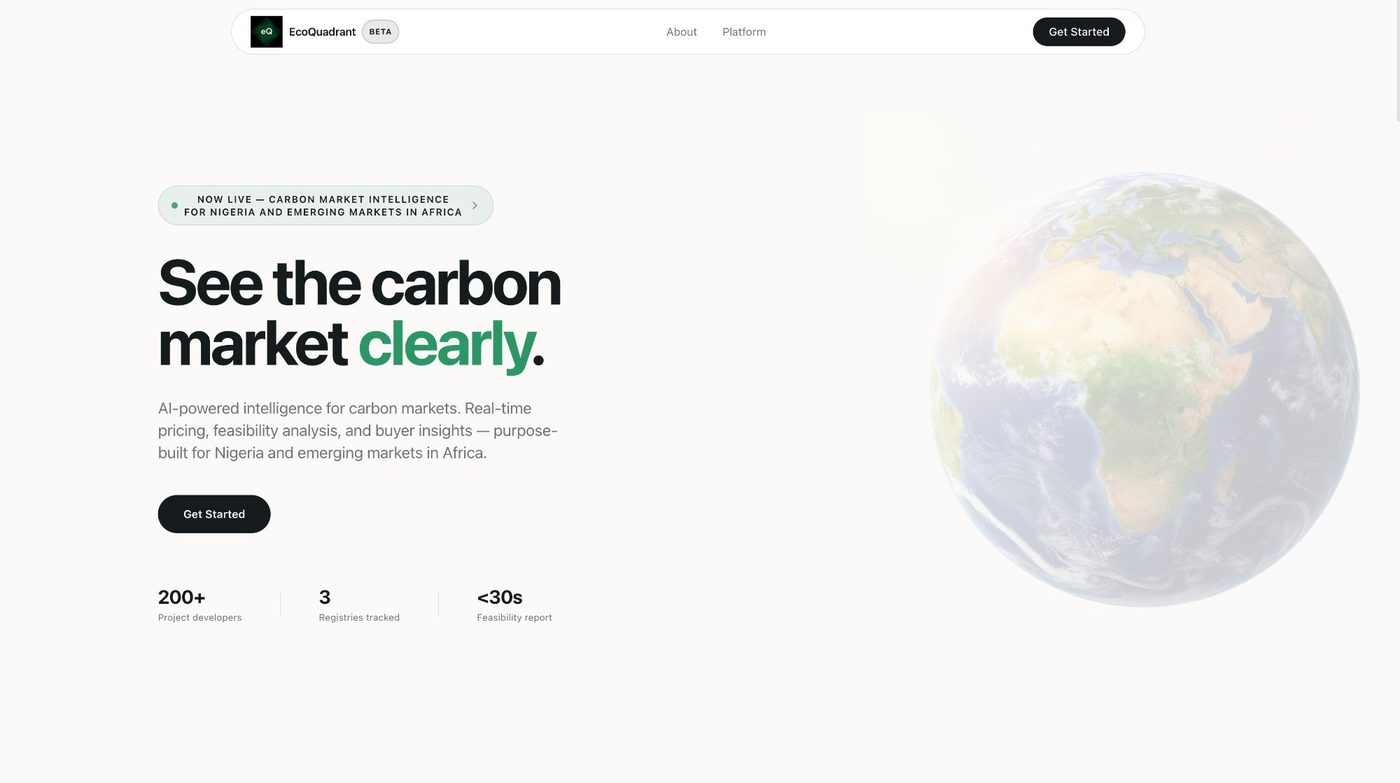
EcoQuadrant positions itself as AI-powered intelligence for carbon markets, with real-time pricing, feasibility analysis, and buyer insights purpose-built for Nigeria and emerging African markets. The homepage reports 200+ project developers, 3 registries tracked, and feasibility reports generated in under 30 seconds.
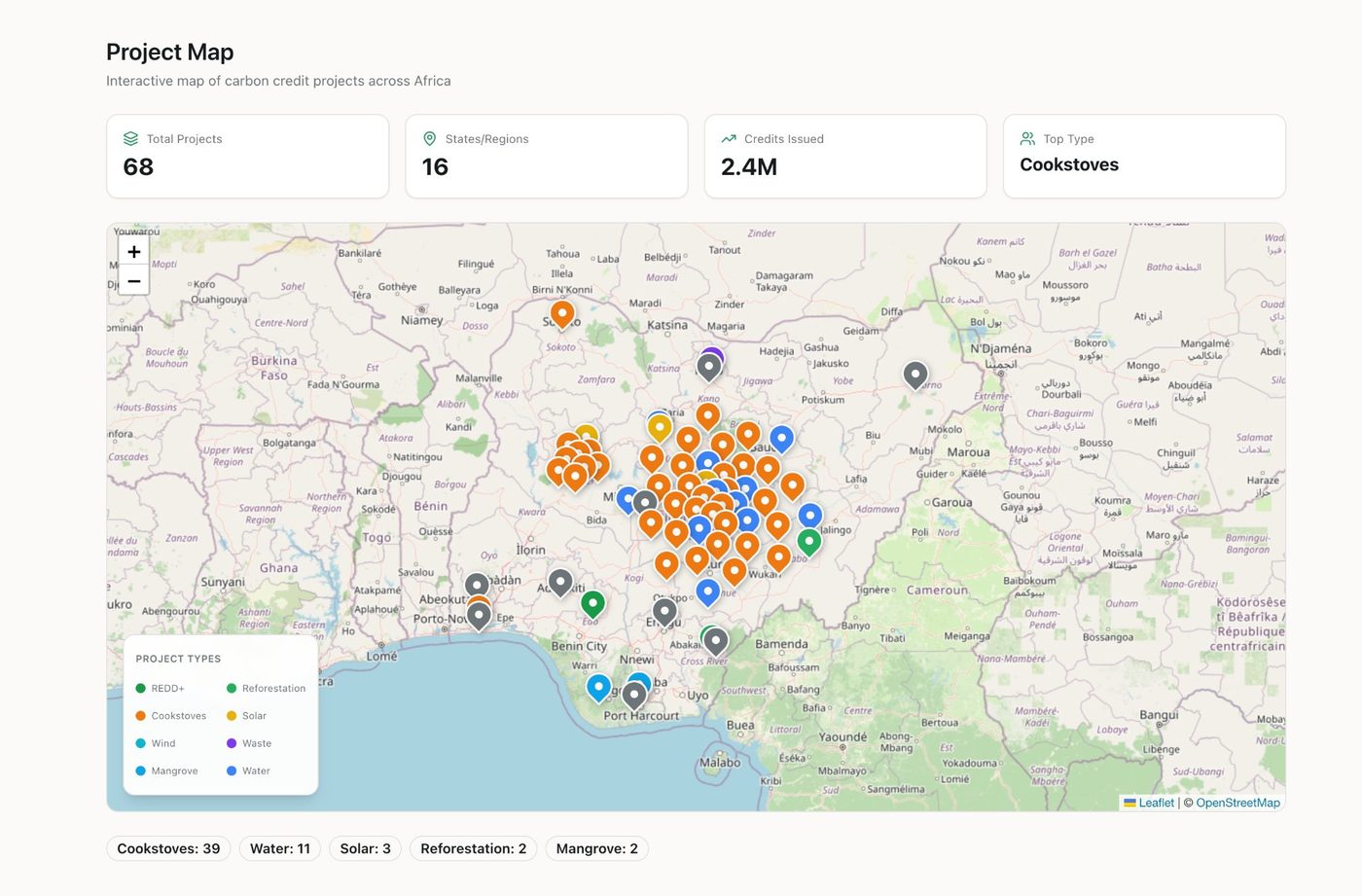
The project map displays 68 geolocated projects across 16 Nigerian states, with 2.4 million credits tracked. Cookstoves dominate at 39 projects, followed by water (11), wind and waste (11), solar (3), reforestation (2), and mangrove (2). The map provides spatial intelligence that static registries cannot offer.
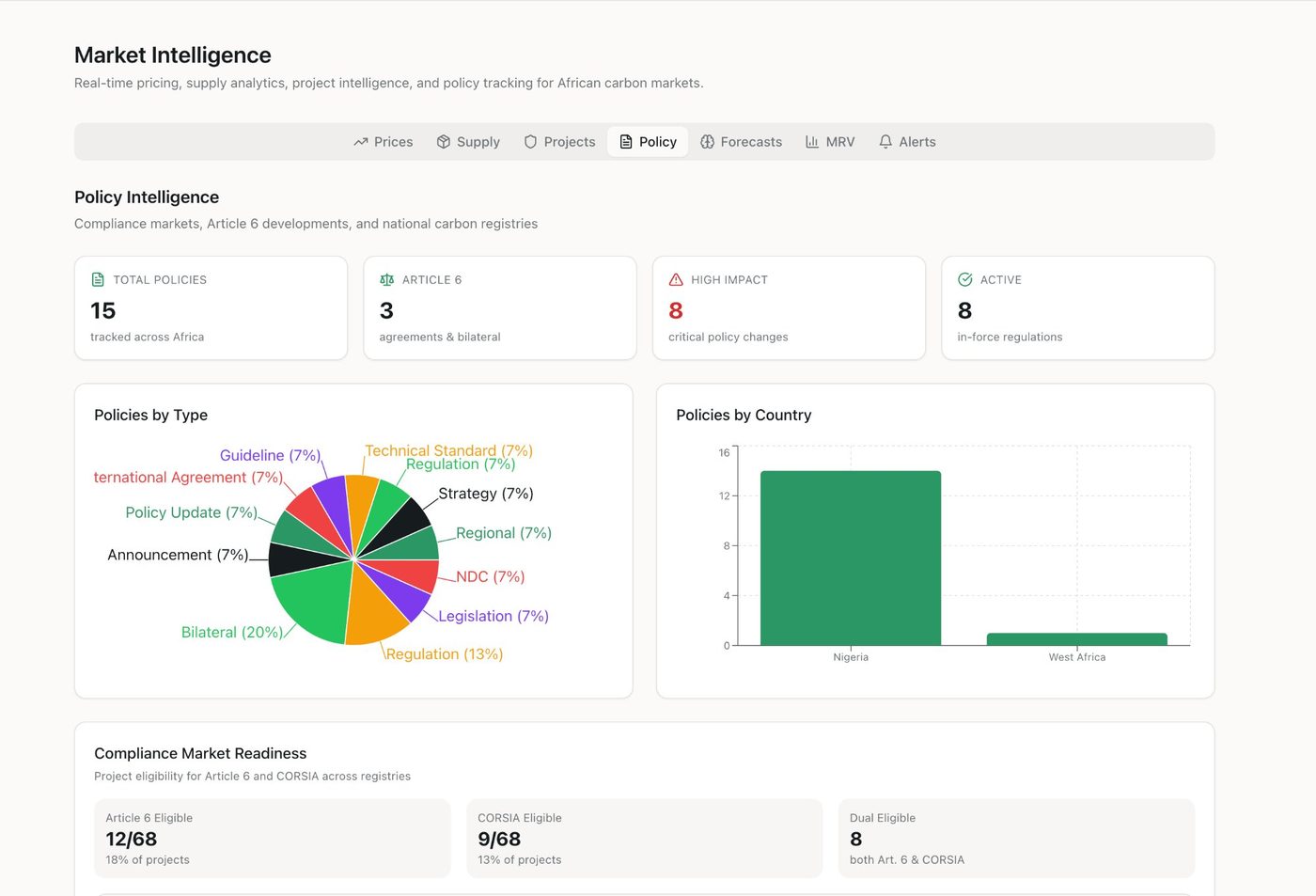
The Policy Intelligence dashboard tracks 15 policies across Africa, including 3 Article 6 bilateral agreements, 8 critical policy changes rated as high impact, and 8 active in-force regulations. Nigeria accounts for the majority. Policies are categorised by type: bilateral (20%), regulation (13%), and a mix of legislation, NDC updates, and technical standards.
The Problem
Project developers and investors in the African carbon market are operating without reliable, unified data. Critical information is scattered across siloed registries, static PDFs, and shifting local policies. There is no single platform connecting global carbon data to domestic African regulation. The result is a transparency discount on African credits, where buyers pay less because they cannot verify what they are buying with confidence.
Average price per tonne CO₂
Different market, different mechanism
Current alternatives, including Verra, Gold Standard, and manual spreadsheet tracking, function as digital filing cabinets. They show that a project was approved, but not how it is performing today. Smaller developers in cookstoves, distributed solar, and clean water bear the highest cost because consultant fees to prove project integrity become a proportionally larger burden at their scale.
What EcoQuadrant Built
A carbon market intelligence platform with three structural features.
Pre-registry visibility. Standard registries show projects only after full verification, which can take two years. EcoQuadrant surfaces projects from the conception phase, allowing developers to showcase projects earlier and giving investors a head start on off-take agreements and climate funding before registry approval.
Policy-to-credit mapping. Nigeria's NCMF and NESREA's mandatory EPR regulations, which became legally binding on 26 February 2026, create compliance requirements that no global platform tracks. Credits that are globally valid but locally non-compliant are worthless under Article 6 frameworks. This local compliance layer is the defensible feature.
dMRV ecosystem integration. EcoQuadrant operates as the commercial layer for Digital Monitoring, Reporting, and Verification firms, supporting their work by translating the complex technical outputs of IoT sensors and satellite monitoring into formats that financial decision makers can evaluate. The platform extends the reach of dMRV providers into the investor-facing layer of the carbon market, where the technical rigour of the underlying data is preserved but rendered in the language of credit pricing, project bankability, and portfolio-level exposure.
Market Context
Four policy shifts shape EcoQuadrant's operating environment. Nigeria officially launched the NCMF in January 2026, creating the regulatory architecture for a domestic carbon market. NESREA's mandatory EPR regulation became legally binding on 26 February 2026, creating demand for plastic credits as producers and importers became legally liable for product lifecycles. Globally, high integrity credits are commanding premium pricing while generic credits decline. Nigeria has established its Designated National Authority for Article 6.4, enabling government to government carbon trading.
Traction
| Metric | Status | Signal |
|---|---|---|
| Beta users | 50+ active | Confirmed |
| Projects captured | 200+ across Nigerian states | Confirmed |
| Projects mapped with geolocation | 68 across 16 states, 2.4M credits | Verified from platform |
| Policies tracked | 15 across Africa, 3 Article 6 | Verified from platform |
| Revenue model | Pre-revenue SaaS | Defined |
| Funding | Bootstrapped | Self-funded |
| Partnerships | Initial/informal conversations with UNIDO, NCCC, and S&P Global | Named, early stage |
| Team | 2 full time | Early stage |
The 50+ figure refers to beta users of the platform, while 200+ refers to projects captured in the system. These measure different things. The product data, including 68 geolocated projects, 2.4 million credits, and 15 policies, is verified from platform screenshots and is structurally sound. EcoQuadrant is in initial conversation with UNIDO, NCCC, and S&P Global as it builds toward institutional partnerships.
Key Milestones
Risks
The founder identifies market validation and adoption as the primary risk, not technology. This is a credible framing for a pre-revenue platform. Payment friction in African SaaS markets, where recurring digital payments are still maturing, and macroeconomic volatility including inflation and currency fluctuations add operational complexity. The binding constraint is converting product quality into paying customers at a pace that sustains the bootstrap model.
What to Look At
Competitive Landscape
| Platform | Geography | Stage | Funding | Focus |
|---|---|---|---|---|
| EcoQuadrant | Nigeria, Africa | Beta | Bootstrapped | Local policy-to-credit intelligence platform powered by AI |
| Sylvera | Global | Series B | $95M+ | AI-powered credit ratings and risk analytics |
| BeZero Carbon | Global | Series B | $50M+ | Carbon credit rating agency model |
| Pachama | Americas, Global | Series B | $79M+ | Remote sensing for forest carbon verification |
| Thallo | Global | Series A | $12M+ | Carbon credit marketplace and exchange |
None of the global platforms have built the localised African policy layer that EcoQuadrant offers. The platform is the only one integrating Nigeria's NCMF, NESREA's EPR framework, and Article 6.4 readiness scoring into a single interface. The defensible position is narrow but structurally real, built on local regulatory knowledge that cannot be easily replicated from a global headquarters.
EcoQuadrant provides the market intelligence needed to unlock verified carbon finance flows by turning fragmented African project data into investable insights.

"Nigeria's path to a $3 billion green economy will not be paved with good intentions or vague policy documents. It will be built on transparent data. If we want to lead the global carbon economy, we must first own our data."Edwin Ehiorobo, Co-Founder · Abuja · ecoquadrant.com
The Climate Ledger View
EcoQuadrant is building the data infrastructure layer for African carbon markets at a moment when the policy architecture, from Nigeria's NCMF to mandatory EPR to Article 6.4, is creating real demand for exactly this kind of platform. The product is live, the pipeline is growing, and the local compliance mapping is a feature that global competitors do not offer.
This is early infrastructure. The platform addresses a structural constraint that will only become more visible as Nigeria's carbon market scales toward its $3 billion target. Watch for the first institutional partnership and the SaaS conversion.
Signal Companies is an editorial feature of The Climate Ledger. Profiles are written independently based on questionnaire submissions and verified platform data. Companies do not have editorial control over the published assessment. This is not investment advice.
Assessment: The Climate Ledger · Source: company questionnaire, platform screenshots, ecoquadrant.com · April 2026