Global renewable installations hit a record 800 GW in 2025, yet the architecture to move that capital into the markets that need it most remains structurally broken. This month's dominant signal is a widening gap between hardware abundance and deployment infrastructure, a mismatch playing out across continents but felt most acutely in Africa, where BNEF forecasts the build rate falling 43% short of the AU's 300 GW target.
In mature markets, corporate PPAs are concentrating capital where grids already work. Microsoft's 40 GW portfolio flows overwhelmingly to jurisdictions with transmission capacity. Africa's carbon credits trade at $3 per tonne while EU permits command €200, exposing the price architecture's failure to value emissions reduction where it happens. Nigeria, characteristically, is moving in multiple directions simultaneously: 16 states now hold electricity transfer orders, the Presidential Villa is building its own microgrid, DARES disbursement has finally begun, and a national carbon registry is operational. Without federal coordination, however, these signals compete rather than compound.
The strategic question is no longer whether clean energy hardware is affordable. It is whether the institutional, regulatory, and financial infrastructure can align fast enough to absorb the capital that is, at least nominally, available. For operators and investors watching African markets, the window between policy ambition and deployment bottleneck is where both risk and opportunity concentrate in 2026.
▶ What to watch: DARES disbursement velocity will determine if $750M reaches communities or stalls in compliance.
What Changed This Month
Grid output (Nigeria)
Baseline issue
→ ~4 GW
DARES disbursement
$750M approved (2023)
→ First grants signed
State transfer orders
Ongoing
→ 16 states active
Carbon registry
Policy finalised
→ Registry operational
CDRI composite
Baseline issue
→ 3.9 / 5.0 (High Risk)
The Big Entry
Global
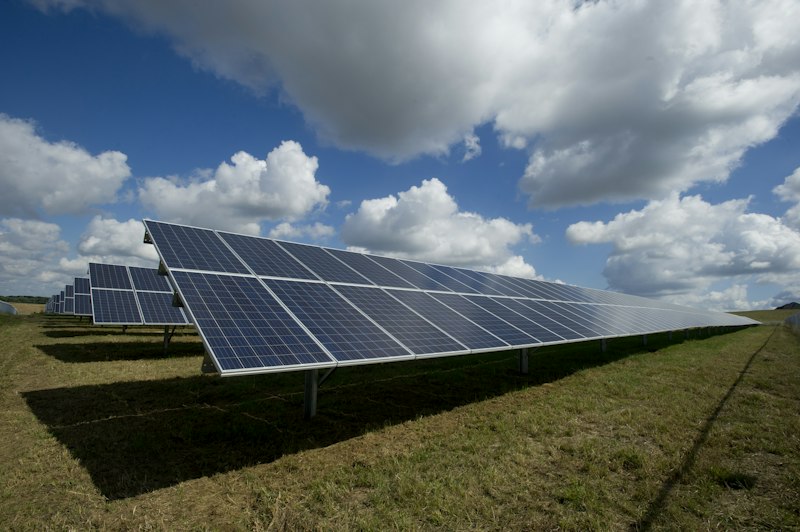
Photo: American Public Power Association / Unsplash
Renewables to overtake coal as largest electricity source globally this year
Global solar and wind installations exceeded 800 GW in 2025, tripling yearly deployments since 2021 (BNEF). Renewables are set to overtake coal by mid-2026, generating an estimated 11,900 TWh. However, growth is expected to decelerate as Chinese policy changes reduce commissioning. For Africa, BNEF forecasts the build rate still falls 43% short of the AU's 300 GW target. AI-driven data centre demand is pulling corporate PPA capital toward mature markets.
Largest corporate PPA portfolio signals where AI-era capital is flowing
Microsoft met its 2025 goal, contracting 40 GW through long-term PPAs. These 10 to 15 year commitments reshape project finance, yet capital flows overwhelmingly to mature grid markets. For African developers: corporate PPA capital follows grid reliability, not resource potential.
14% of global voluntary supply · "Carbon grab" concerns grow
Africa accounts for ~14% of global voluntary supply, with ~300 million credits issued and $1.2 billion retired. Foreign buyers pay as little as $3/tonne while EU permits command ~€200. Former AfDB President Adesina has described this disparity as value extraction from host countries.
China's solar rose 35% to 1,200 GW and wind 23% to 640 GW. Non-fossil sources could reach 63% of China's power mix in 2026. Chinese module oversupply keeps costs low for African importers, though new pricing policies create uncertainty.
KenGen exploring new geothermal fields in Suswa, Menengai, and Baringo. Egypt's capacity nearly doubled since 2015. Morocco's Noor Ouarzazate CSP complex (510 MW) fully operational. These demonstrate global-standard execution but underscore geographic concentration.
SA's Phase 2 carbon tax raised offset allowances to 10 to 15%. JSE traded credits at $8.25/tCO₂e. Nigeria's Carbon Market Activation Policy introduces an Article 6 aligned registry. CDM transition deadline extended to June 2026. Africa's two largest economies are building domestic carbon pricing infrastructure.
Nigeria's Energy Transition Plan outlines a structural transformation of the power sector. Installed capacity is projected to grow 6.8× by 2060 with renewables rising toward 80% of the generation mix by mid-century. Solar becomes the dominant technology. Diesel and small-scale self-generation are gradually displaced. Universal electricity access requires approximately $25.8 billion.
The direction is clear: scale centralised clean capacity, modernise the grid, phase down diesel, unlock distributed solar where efficient.
That is the strategy. Now compare it to current signals.
16 states now hold transfer orders under the Electricity Act reforms. Net billing frameworks are emerging. Subnational regulators are forming. Tinubu-era reforms have attracted over $2B in new power sector investment.
Signal
Regulatory fragmentation risk is rising. Investors now assess state-level rule stability alongside federal NERC exposure. Due diligence complexity increases and capital deployment may stall unless harmonisation improves. The ETP assumes coordinated grid densification. Sixteen separate regulatory environments work against that assumption.
The Presidential Villa allocating ₦17B for an off-grid microgrid is not symbolic. It is structural. Grid unreliability remains severe enough that the seat of government itself is exiting the system. Manufacturers continue to report energy costs at 30 to 40% of total production.
Signal
C&I and institutional off-grid solar remains economically rational. Diesel displacement continues at pace. The ETP envisions stronger centralised infrastructure over time but if off-grid growth outpaces grid reform then system coordination risk increases. Distributed solar is investable today. Whether grid-scale capital follows is the open question.
NERC continues to phase out electricity subsidies with service-reflective tariff adjustments for Band A customers while rural electrification agencies are channelling REA funds toward mini-grid developers. The World Bank's Nigeria Distributed Access through Renewable Energy Scale-up (DARES) project is designed to deploy solar home systems and mini-grids across underserved states.
Signal
Tariff reform is necessary but politically fragile. The move toward cost-reflective pricing improves the revenue outlook for grid operators and independent power producers. Simultaneously, mini-grid financing signals growing recognition that centralised grid extension alone will not achieve universal access by 2030. These two tracks must run in parallel for the ETP to stay credible.
Nigeria's Carbon Market Activation Policy and national registry, aligned with Article 6, aim to mobilise approximately $2.5B in climate finance by 2030. The ETP prices the full net-zero transition at $410B.
Signal
Government is building pricing mechanisms to monetise decarbonisation. If price integrity improves then carbon-linked revenue could support grid-scale renewables or methane abatement. Prices across much of Africa remain near $3 per tonne. At that level impact stays marginal. Carbon markets are one instrument in a much larger toolkit and cannot substitute for concessional finance, grid investment or solar home system deployment.
At NIES 2026, TotalEnergies reaffirmed its dual-pillar strategy of growing oil and gas alongside integrated power solutions. The AKK Gas Pipeline mainline is complete and over $8B in gas FIDs have been unlocked.
Signal
Directionally aligned with ETP modelling which assumes gas supports reliability during renewable scale-up. The risk is real though. Gas infrastructure investment may crowd out grid-scale renewables if capital allocation tilts toward fossil lock-in rather than bridging toward the 82% target. Gas is ETP-consistent as a bridge. The question is the length of that bridge and what it displaces.
The ETP requires massive transmission investment, coordinated regulatory architecture, capital mobilisation at scale and gradual diesel phase-down. Current signals tell a different story. Regulatory decentralisation is advancing without full harmonisation. Distributed solar is scaling rapidly but driven by grid failure rather than system design. Tariff reform is progressing but remains politically exposed. Carbon pricing infrastructure is still embryonic. Gas expansion continues.
Globally, hardware cost declines are time-limited as Chinese policy shifts slow commissioning. Africa's carbon credits trade near $3 per tonne against EU permits at €200. That gap alone tells you the financing architecture is not yet built for the scale of transformation the ETP demands.
The core question for investors is not whether Nigeria will transition. It is whether the system architecture will align fast enough to absorb capital efficiently. Without coordinated investment in transmission, distribution and storage Nigeria risks building generation capacity that cannot reach the 85 million households still without power.
Voice From the Field
"The grants are there. The applications are not. Most community developers do not know the DARES window exists. The ones who do cannot navigate the compliance requirements alone. We need intermediaries who understand both the funder language and the local reality."
Solar project developer, Lagos
Shared with The Climate Ledger, February 2026
Deployment Risk Watch
🇳🇬 The Adoption Gap
Billions on the Table, Millions in the Dark
Nigeria's clean energy adoption scorecard: funding, readiness, risk and opportunity
Part 1 · Capital Access
The Money That Goes Unclaimed
International climate finance flowing into Nigeria hit $2.5 billion in 2021/22 according to the Climate Policy Initiative. That sounds significant until you compare it to $9.3 billion spent on fossil fuel subsidies in the same year or the $6.7 billion in flood damage losses in 2022 alone. Climate finance amounts to less than 1% of GDP.
The real problem is not availability but access. The World Bank's DARES project approved $750 million in 2023 to deliver distributed renewables to 17.5 million Nigerians. The first grant signings with eight renewable energy companies only happened in 2025. A new $500 million DRE Nigeria Fund was announced in March 2025 by NSIA, SEforALL, the International Solar Alliance and Africa50. The federal government allocated ₦100 billion in the 2025 budget for solar in public institutions.
Yet 80 million Nigerians still lack electricity access. Grants exist. Funds are structured. Applications go unfiled. Local businesses and communities are not informed, not connected and not applying. The pipeline between global capital and Nigerian communities remains broken at the last mile.
Part 2 · Safety Infrastructure
Safety: The Risk Nobody Is Preparing For
As solar, battery storage and electric vehicles scale across Nigeria, a safety infrastructure gap is widening. Lithium-ion battery fires are rare globally with EVs experiencing roughly 25 fires per 100,000 vehicles compared to 1,530 per 100,000 for petrol cars. But when they happen they are complex, long-burning and require specialist response capacity that Nigeria does not have.
Nigeria's Federal Fire Service is critically underfunded. A 2025 study in the Public Organization Review found the service suffers from gross neglect, continuous deprivation and underfunding by both state and federal governments. Nigeria ranks 31st globally for fire deaths. The country lost an estimated ₦3 trillion to 2,845 fire outbreaks in 2021 alone. Lagos recorded over 6,000 fire incidents between 2010 and 2015. These numbers reflect a system already overwhelmed by conventional fires before lithium batteries, solar inverters and energy storage systems enter the picture at scale.
Solar installation fires in Nigeria are increasingly linked to unqualified installers, battery mismatches, missing battery management systems, overcharging from faulty inverters and poor maintenance. The most common cause is not the technology itself but the gap between what is installed and who installs it.
Part 3 · Market Opportunities
Where Local Businesses Can Bridge the Gap
The adoption challenge creates a market. Businesses that position themselves at the intersection of access, safety and quality will capture demand that is growing regardless of policy.
Five Gaps Waiting to Be Filled
1. Certified Installation & Maintenance
Most solar fire incidents trace back to unqualified installation. Businesses that invest in NABCEP-equivalent certification, proper BMS integration and post-installation monitoring can differentiate on safety in a market full of cut-price competitors.
2. Fire Safety Services for Clean Energy
With the Federal Fire Service unable to respond to conventional fires adequately, private fire safety and emergency response for solar farms, battery storage and EV charging infrastructure is an open market. Training, equipment supply and rapid-response contracts all sit unfilled.
3. Grant Access Consultancy
The REA, World Bank DARES, AfDB SEFA and multiple bilateral programmes have open funding windows that Nigerian SMEs are not applying to. Businesses that help communities and local developers navigate application processes, compliance requirements and project structuring can unlock capital while building their own pipeline.
4. Last-Mile Distribution for Solar Home Systems
The DARES project and DRE Nigeria Fund both need distribution partners. Companies with logistics networks in underserved states can become the bridge between international capital and Nigerian households.
5. EV & Gas System Safety Infrastructure
As CNG conversion programmes scale and early EV adoption begins, safety training, inspection services and emergency preparedness consulting are essential but largely absent. The business that builds this capability now will own it when regulation catches up.
Part 4 · Assessment
The Adoption Scorecard
Nigeria Clean Energy: Where the Money Goes
Adoption Readiness: What's Working vs What's Broken
Indicator
Status
Trend
International funding available
$2B+ in active programmes
↑ Growing
Local grant uptake rate
Low. First DARES signings took 2 years
→ Stalled
Certified solar installers
Severely undersupplied
↓ Critical gap
Fire service readiness for clean energy
Near zero. No lithium/BESS protocols
↓ Critical gap
EV/CNG safety infrastructure
Absent. No inspection regime
↓ Critical gap
Off-grid solar adoption
5.5M people reached via NEP phase 1
↑ Accelerating
Solar import tariffs
Zero duty/VAT under ECOWAS CET
↑ Favourable
Local business participation
Growing but informal and fragmented
→ Opportunity
The pattern is clear. Capital is available. Technology works. Import conditions are favourable. But the connective tissue between international funding and Nigerian adoption is weak. Safety infrastructure is almost nonexistent for the technologies being deployed. The businesses and communities that build this connective tissue, from certified installation to grant navigation to emergency response, will define whether Nigeria's energy transition reaches 200 million people or stays trapped in pilot projects.